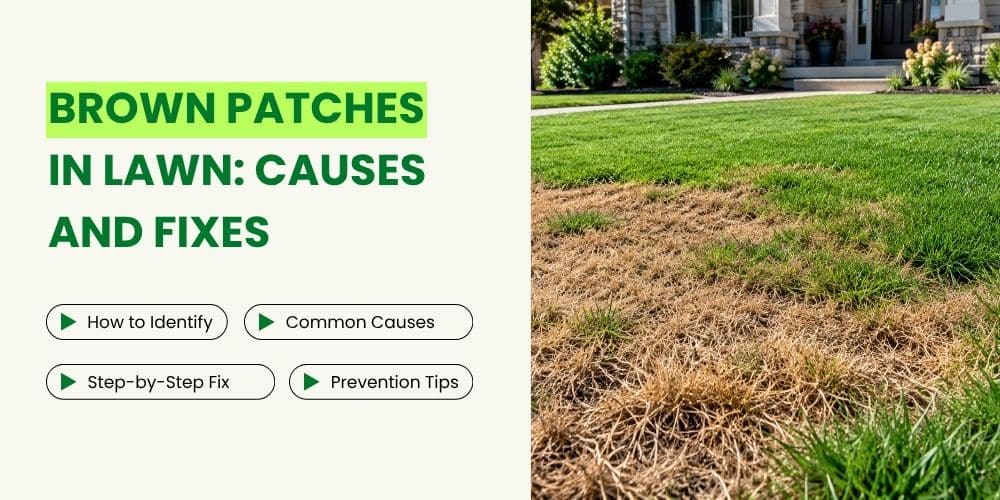
Last week the lawn looked fine. This week there’s a brown circle in the yard, and it’s bigger than yesterday.
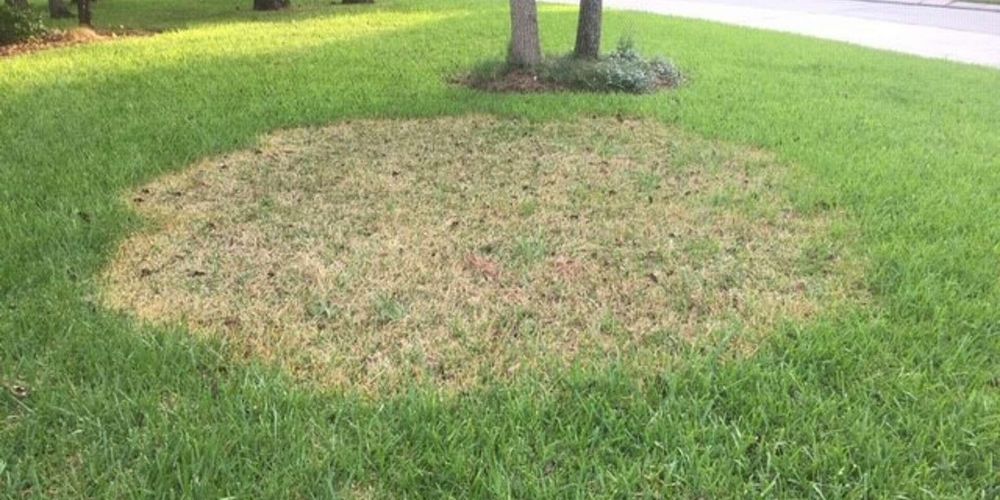
If the patches are roughly circular and the blades pull off easily at the base, you’re probably looking at brown patch fungus.
If they aren’t, something else is going on, and fungicide won’t help.
This guide shows you how to confirm the fungus in four minutes, rule out the look-alikes, treat it at the right time, and repair the damage, whatever your grass type.
It’s probably brown patch fungus if:
- the patches are circular, from a few inches to several feet across
- blades pull off at the base with dark rot
- you see cobweb-like threads or a smoky ring on a dewy morning
- it showed up after hot, humid weather (or, in warm-season grass, a cool, wet fall)
What Is Brown Patch Fungus?
Brown patch is a lawn disease caused by the fungus Rhizoctonia solani. It already lives in the soil and thatch of most lawns, and weather decides whether it wakes up. It isn’t contagious like a cold, but once it’s active it spreads across your lawn.
The naming trips people up. In cool-season grass like tall fescue it’s called brown patch. In warm-season grass (St. Augustine, zoysia, Bermuda, centipede, buffalograss) Texas A&M AgriLife calls it large patch. It’s the same fungus in a different season, and plenty of Texans still say brown patch. We use both names here.
How to Identify Brown Patch Fungus: A 4-Minute Check
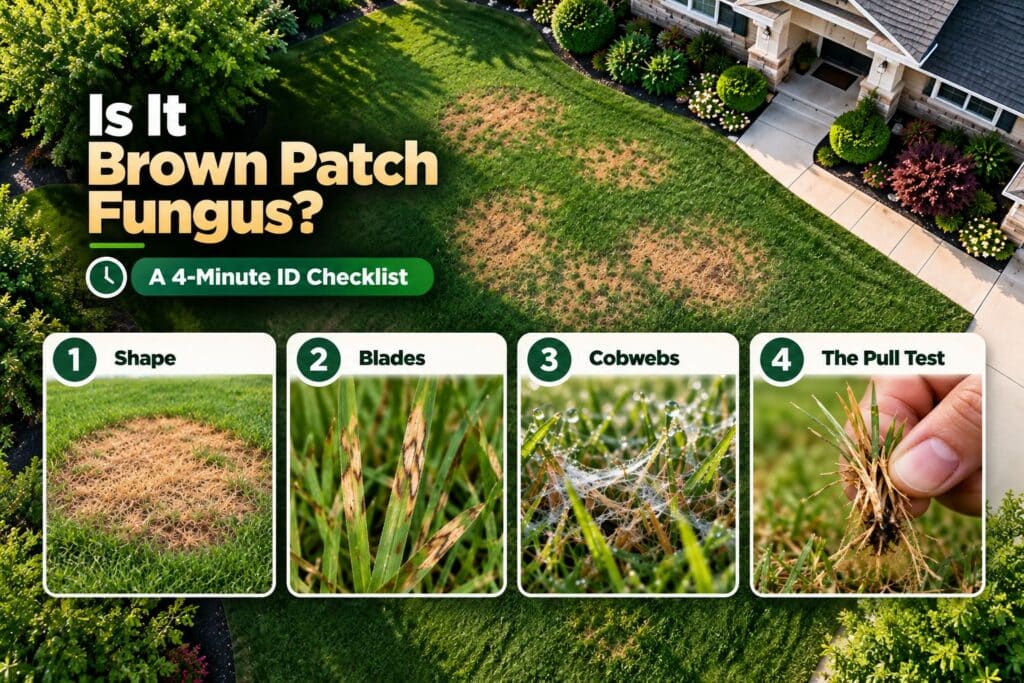
Go out early, while the grass is still wet.
1. Look at the Shape:
Brown patch makes roughly circular patches, a few inches to several feet across. On short-cut turf you may see a dark, smoky ring at the edge in the morning.
2. Look at the Blades:
On tall fescue, infected blades show tan, irregular lesions with a dark brown border. On St. Augustine and zoysia, look for circular patches with orange or yellow edges. The orange leaves are freshly infected.
3. Look for Cobwebs:
On a humid morning, white, cobweb-like threads (mycelium) may cover the blades. They’re gone by midday.
4. Do the Pull Test:
Tug a few blades at the edge of the patch. If they slip off at the base with dark brown rot, it’s fungus. On St. Augustine and zoysia, shoots slide out of the sheath where it meets the stolon. Texas A&M calls this a practical way to diagnose large patch in the field.
Pro tip: Take a photo of the patch at sunrise and again at noon. Fungus signs fade by midday, and the before/after is useful if you end up calling a pro.
What Causes Brown Patch in Lawns?
The fungus needs three things at once:
- Heat and humidity: In cool-season grass, that means days around 80°F or hotter and nights that stay above roughly 65 to 68°F (Penn State Extension).
- Wet grass for long stretches: Evening sprinklers, heavy dew, shade, and poor drainage all keep blades wet. A University of Florida extension agent points to leaves staying wet 48 hours or more.
- Soft, lush growth: A big nitrogen feeding right before a hot, humid week.
The habits that set it up are watering at night, quick-release nitrogen, thick thatch, shade and poor drainage. Lawns less than a year old get hit harder (Penn State). Texas A&M says large patch is especially severe in turf that’s poorly drained and over-fertilized.
Brown Patch vs. Large Patch: Cool-Season vs. Warm-Season Grass
| Brown patch | Large patch | |
| Grass | Tall fescue, ryegrass, other cool-season | St. Augustine, zoysia, Bermuda, centipede, buffalograss |
| Season | Hot, humid summer | Spring and fall, cool and wet |
| Trigger | Warm nights, humidity | Temperatures below 70°F (A&M). October to November in Texas |
| Attacks | Mostly leaf blades | Sheaths, stolons and roots |
| Recovery | Mature turf usually bounces back | Won’t recover until the following spring. Heavy damage may need resodding |
| Fungicide timing | At the first sign, or before a hot, humid stretch | Before symptoms, as fall soil drops below 70°F |
Brown Patch in Tall Fescue
Tall fescue is one of the most susceptible cool-season grasses. Tan blades can make the whole lawn look dull rather than patchy. Penn State recommends moderate summer nitrogen on fescue lawns with a history of brown patch.
Brown Patch in St. Augustine and Zoysia (Large Patch)
A&M calls large patch the most chronic and economically important disease of St. Augustine and zoysia in Texas. Look for orange or yellow edges and do the stolon pull test.
Brown spots in early September are rarely large patch. The fungus wants cool, wet weather. Texas horticulturist Neil Sperry suggests watching for circular yellowing after the first cool, rainy spell of fall, around 60°F.
Brown Spots in Bermuda Grass
Bermuda can get large patch in spring and fall. If it browns in midsummer, think drought, grubs or dollar spot first.
Is It Really Brown Patch? Brown Spots in Lawn That Aren’t Fungus
Rule these out before you spend money.
| What you see | Likely cause | Quick test or fix |
| Small silver-dollar spots, hourglass-shaped lesions | Dollar spot | Often in underfed lawns |
| Turf peels like carpet, roots chewed | Grubs | Peel back a one-foot square and count. A&M’s threshold is 5 to 10 per square foot, with damage |
| Straw-brown streaks in hot, sunny St. Augustine, watering doesn’t help | Chinch bugs | Coffee can test (below). Threshold is about 20 to 25 per square foot |
| Dead spot with a dark green ring | Dog urine | Soak with water. Baking soda and gypsum can make it worse (Colorado State) |
| Stripes after feeding or spraying | Fertilizer or chemical burn | Soak deeply for several days |
| Dry soil, crispy blades, live roots | Drought | Screwdriver won’t go in six inches. Check for a sprinkler leak or dry zone |
| Short, black, rotted roots on St. Augustine in spring | Take-all root rot | Check the roots |
| Gray-brown lesions on St. Augustine in humid summer | Gray leaf spot | Check the blades |
| Greasy look, worsening within hours | Pythium blight | Hot, soggy weather |
| Whole lawn tan after a freeze | Dormancy | Nothing to fix. Don’t fertilize. See our winter lawn care guide |
Coffee can test for chinch bugs: cut both ends off a can, press it a few inches into the turf at the edge of the damage, fill it with water and wait about ten minutes. Bugs float up. A&M’s chinch bug guidance and the Dallas County Master Gardeners explain the method. Big-eyed bugs look similar but eat chinch bugs.
Scalping, dull mower blades, compacted soil, and thick thatch also brown grass and invite fungus.
Brown Patch vs. Dollar Spot:
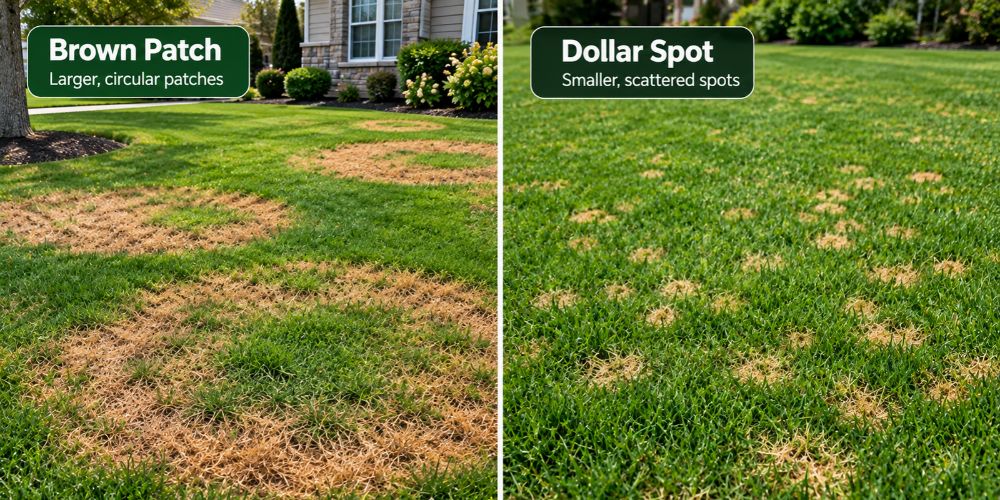
The most common mix-up. Brown patch makes big circles and loves excess nitrogen. Dollar spot makes small spots, often in a hungry lawn. If you feed heavily and see big circles, suspect brown patch. If the lawn is underfed and the spots are small, suspect dollar spot.
How to Treat Brown Patch Fungus (Step by Step)
Start with the conditions, not the sprayer. Most mild cases never get past Step 4.
Step 1: Stop Feeding the Fungus
Hold quick-release nitrogen until the outbreak passes. Soft, lush growth is exactly what brown patch feeds on. When the lawn needs food again, switch to a slow-release fertilizer.
Step 2: Water Early in the Morning
Water in the early morning so the blades dry well before dusk. Wet grass overnight is the setup the fungus likes best. Water only when the lawn actually needs it. Do the screwdriver test first, because extra water makes fungus worse. Then check that your irrigation system timer isn’t set for the evening.
Step 3: Mow the Right Way
- Height: Texas A&M recommends 2 to 3 inches for St. Augustine and 1 to 2 inches for zoysia.
- Blades: Keep them sharp. A clean cut stresses the grass less.
- Timing: Mow when the grass is dry.
- Clippings: Bag them from the affected area so you don’t carry the fungus to healthy turf.
Step 4: Open Up the Lawn
Fungus thrives where air and sunlight can’t dry the grass. Give the lawn room to dry out:
- Let in light and air: Prune low branches over the affected area.
- Reduce thatch: Aerate and dethatch if the thatch layer is thick. Excess thatch holds moisture at the base of the grass.
- Fix drainage: Correct low spots where water pools. A French drain is the permanent fix for chronic soggy areas.
Step 5: Decide Whether You Need Fungicide
Fungicide is the backup, not the plan. Whether it’s worth buying depends on your grass, the season and how fast the patches are spreading. The next section walks you through it.
Brown Patch Fungicide: When It’s Worth It
- Mild patches in mature turf, cooler weather coming: usually no.
- Brown patch history and a hot, humid week forecast: yes, preventively.
- Patches spreading fast: yes, now.
- Warm-season lawn, symptoms already showing in spring: skip it. A&M says spring applications aren’t cost-effective.
- Warm-season lawn, fall soil dropping below 70°F, history of large patch: yes, preventively, before symptoms.
Timing matters more than product. A&M says fungicide works best applied before symptoms and has limited effect once the disease is active. A San Antonio-area A&M horticulturist has also cautioned that fungicides can be unreliable on home lawns.
What to Look for on the Label
- The label names your grass type and the disease (brown patch or large patch).
- The active ingredient appears in a university fungicide table, such as the one in A&M’s large patch guide. Azoxystrobin, propiconazole, myclobutanil and thiophanate-methyl all do. A few products in that table aren’t for home lawns, so check the label.
- You follow every rate and timing instruction.
- If you apply more than once, rotate chemical classes. Repeating the same one can build resistance.
To time it for warm-season grass, push a digital thermometer four inches into the soil each morning for a few days. A soil-temperature tool like GreenCast Online also works.
How to Fix Brown Spots in Lawn After Brown Patch
Will it grow back? Usually. Mature cool-season grass often recovers once nights cool and the weather dries. Large patch damage fills in as temperatures rise in late spring and summer, unless crowns and roots are badly damaged. Then resodding the area may be the only fix.
Repair steps:
- Wait until the outbreak has passed.
- Rake out the dead grass and loosen the top inch or two of soil.
- Replace the grass (table below).
- Keep it moist until it roots. Ask your city whether new landscaping is exempt from watering limits.
- Skip pre-emergent herbicide where you’re seeding, because it blocks new seed. Bare spots also invite weeds, so see how to get rid of weeds in your lawn.
| Grass | Best repair | Best timing |
|---|---|---|
| St. Augustine | Sod or plugs, not seed | Warm months, while it’s growing |
| Bermuda | Seed, sprigs, plugs or sod | Late spring to early summer |
| Zoysia | Plugs or sod | Late spring through summer |
| Tall fescue, ryegrass | Seed | Early fall |
Fertilizer for brown grass: hold off during an outbreak. After recovery, A&M suggests feeding warm-season lawns about six weeks before the first frost and three weeks after green-up. Once the patches fill in, see how to make grass greener, or let our fertilization and weed control service handle the schedule.
How to Prevent Brown Patch
- Water early in the morning, deeply and infrequently.
- Mow at the right height with a sharp blade.
- Skip quick-release nitrogen before hot, humid stretches, and avoid heavy late-fall feeding on warm-season grass.
- Aerate and dethatch when needed, and prune trees so the lawn dries out.
Round Rock and Austin calendar:
| Month | What’s happening | What to do |
| Mar to Apr | Green-up. Spring large patch can show | Hold fertilizer until about three weeks after green-up (spring fertilizing guide). Don’t restart watering too early |
| Jul to Aug | Heat stress and chinch bugs, not large patch | Run the can test before treating. See our summer lawn care tips |
| Sep | Still hot. Early brown spots are rarely large patch | Hold off on fungicide. Start tracking soil temperature |
| Oct to Nov | Large patch window. First cool, wet spell. Soil below 70°F | Preventive fungicide only if you’ve had it before |
| Dec to Feb | Dormancy | Rest. Don’t fertilize |
The watering trap: Round Rock’s year-round rules cap watering at two days a week and ban it from 10 a.m. to 7 p.m. They allow it after 7 p.m. Don’t. Evening water keeps grass wet all night. Set the controller for before 10 a.m. Austin’s rules differ and change with drought stage, so check your city’s current schedule. Not sure your timer is right? Get your irrigation checked.
Mistakes That Make Brown Patch Worse
- Fertilizing to “green it back up.”
- Watering at night, even when the rules allow it.
- Spraying fungicide before you’ve confirmed fungus.
- Calling September spots large patch.
- Mowing wet, infected turf and spreading fungus on the mower deck.
- Seeding or sodding before the conditions are fixed.
When to Call a Pro
Call someone if the patches keep spreading after you’ve fixed watering and feeding, if you can’t tell what’s causing it, or if the same spots come back every year.
When you call, send your sunrise photo, your noon photo and your pull-test result. And ask any company that diagnoses your lawn to show you what they found: the pull test, the soil temperature, the bug count. If someone sprays first and explains later, ask why.
Based in Round Rock, Pflugerville, Hutto, North Austin, Cedar Park or Georgetown? The Works Lawn Service can take a look. Send us a photo of the patch, and we’ll tell you what we think is going on. Or see our lawn care services.
FAQs
Will brown patches in my lawn grow back?
Often. Mature cool-season grass usually recovers once the weather cools and dries. Large patch damage typically fills in the next spring. Severe root and crown damage may need resodding.
Is brown patch contagious?
Not like a cold. The fungus is already in the soil and thatch. Weather decides whether it activates, and it can spread within your lawn.
Should I water brown spots more?
Only if the soil is dry. Fungus gets worse with extra water. Run the screwdriver and pull tests first, and see the signs of overwatering.
How long does brown patch last?
As long as the conditions do: hot, humid weather for brown patch, cool, wet weather for large patch. Patches generally stop spreading when the weather changes.
Does brown patch kill grass?
In cool-season grass it mostly damages blades, so mature turf often recovers. Large patch attacks sheaths, stolons and roots, which is more serious.
Can I fix brown patch without fungicide?
For mild cases, yes. Morning watering, proper mowing, less nitrogen and better airflow are often enough.
What is the best fungicide for brown patch?
There isn’t one best product. Pick one labeled for your grass type and for brown patch or large patch, with an active ingredient from a university fungicide table, and apply it on the right schedule.
Is brown patch the same as large patch?
Same fungus, different grass and season. Brown patch hits cool-season grass in hot, humid summers. Large patch hits warm-season grass in cool, wet spring and fall weather.