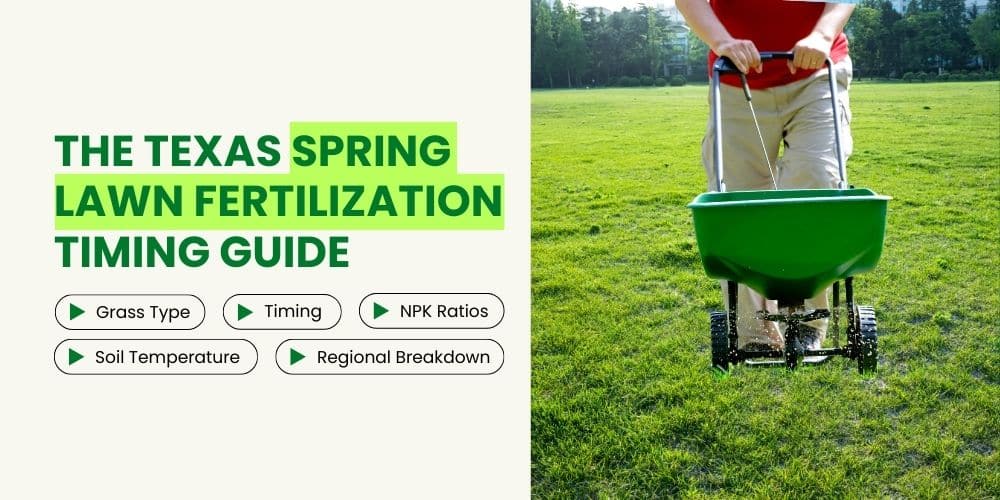
The best time to fertilize your lawn in Texas spring is after your soil temperature consistently reaches 65°F and your grass has been mowed two to three times, typically from February in the Rio Grande Valley, mid-March along the Gulf Coast and East Texas, late March to mid-April in Central Texas (Austin, San Antonio, Waco), early to late April in North Texas (Dallas, Fort Worth, DFW), and late April to early May in the Panhandle (Amarillo, Lubbock). Apply too early, and you are feeding weeds, not your lawn. Apply too early, and you’re literally throwing money into the ground. Apply too late, and you’ve missed the critical green-up window.
The exact timing still depends on your grass type, your specific region, and the fertilizer you are using. Read on for the complete breakdown.
What You Will Learn in This Guide
- Why soil temperature, not the calendar, is your number one trigger for spring fertilization
- Exact fertilization windows for North, Central, South Texas, and the Gulf Coast
- Grass-by-grass breakdown: Bermuda, St. Augustine, Zoysia, Centipede, Buffalo, and Fescue
- The NPK ratios that actually work in Texas spring conditions
- Trusted tools and maps to check soil temperature and frost dates in real time
- Common fertilization mistakes that destroy Texas lawns every spring
- A complete spring fertilization schedule you can follow today
Why Timing Is Everything in Texas Spring Lawn Fertilization
Texas is not a monolith. When you say “Texas spring,” you could be talking about 45-degree mornings in Amarillo in March or 80-degree afternoons in Brownsville in February. These are completely different lawn care realities.
Here is the principle that overrides everything else:
Fertilize when your grass is actively growing, not when the calendar tells you to.
Fertilizer applied to dormant or semi-dormant grass is wasted at best and damaging at worst. Nitrogen sitting in cold soil gets leached away by spring rains or causes root burn in grass that is not yet metabolizing actively.
The Soil Temperature Rule: How to Check It Right Now
Before you touch a fertilizer bag, you need one number: your current soil temperature at a depth of 2 to 3 inches. Here is what the readings mean for Texas lawns:
| Soil Temp | Grass Status | Should You Fertilize? |
|---|---|---|
| Below 50 F | Fully dormant | No. Wait. |
| 50 to 55 F | Waking up slowly | No, still too early |
| 55 to 60 F | Pre-green-up | Only for cool-season grasses (Fescue) |
| 60 to 65 F | Active growth beginning | Yes: warm-season grasses are ready |
| 65 to 75 F | Peak spring growth | Yes, ideal window for all Texas grasses |
| Above 85 F | Heat stress approaching | Stop. Switch to the summer program. |
Live Soil Temperature Map: Check Your Exact Location
Do not guess. Use the Greencast Soil Temperature Map by Syngenta to see real-time soil temperatures across all Texas counties. Simply zoom into your city, click your location, and you will see the current 2-inch and 4-inch soil temperatures alongside a 5-day forecast.
Pro Tip: Get a Soil Thermometer, a basic $12–15 soil thermometer from any garden center will save you hundreds of dollars in wasted fertilizer and lawn repair costs. It’s the single best investment a Texas homeowner can make.
Texas Spring Fertilization Windows by Region
Texas spans 268,000 square miles across multiple USDA hardiness zones. The spring fertilization window shifts by 8 to 10 weeks from the Rio Grande Valley to the Panhandle. Here is how timing breaks down:
| Region | Major Cities | Soil Hits 65 F | First Spring Fertilization |
|---|---|---|---|
| South Texas / Rio Grande Valley | McAllen, Laredo, Brownsville | Late January to February | February to Early March |
| Gulf Coast | Houston, Galveston, Corpus Christi | Early to Mid March | Mid-March to Early April |
| Central Texas | Austin, San Antonio, Waco | Mid-March to Early April | Late March to Mid April |
| North Texas / DFW | Dallas, Fort Worth, Denton | Late March to Mid April | Early to Late April |
| West Texas | El Paso, Midland, Odessa | Mid-March to Early April | Late March to Mid April |
| East Texas / Piney Woods | Tyler, Longview, Nacogdoches | Early to Mid March | Mid-March to Early April |
| Panhandle / North Plains | Amarillo, Lubbock | Mid to Late April | Late April to Early May |
Find Your Exact Last Frost Date
Before spring fertilization, confirm that your last frost date has passed or is safely close. The Texas A&M AgriLife Extension Freeze Date Tool provides county-by-county average last frost dates across Texas. For a visual national map, the Old Farmer’s Almanac Frost Date Calculator lets you enter any Texas zip code and instantly see average first and last frost dates, which is helpful for timing both fertilization and pre-emergent applications.
Spring Fertilization by Grass Type in Texas
Your grass type is the second most critical factor after soil temperature. Texas has six dominant turf grass varieties, each with unique spring requirements.
1. Bermuda Grass: Most Common in Texas
Bermuda is the most widely grown warm-season turf in Texas, thriving from Dallas to El Paso. It is aggressive, heat-loving, and nutrient-hungry.
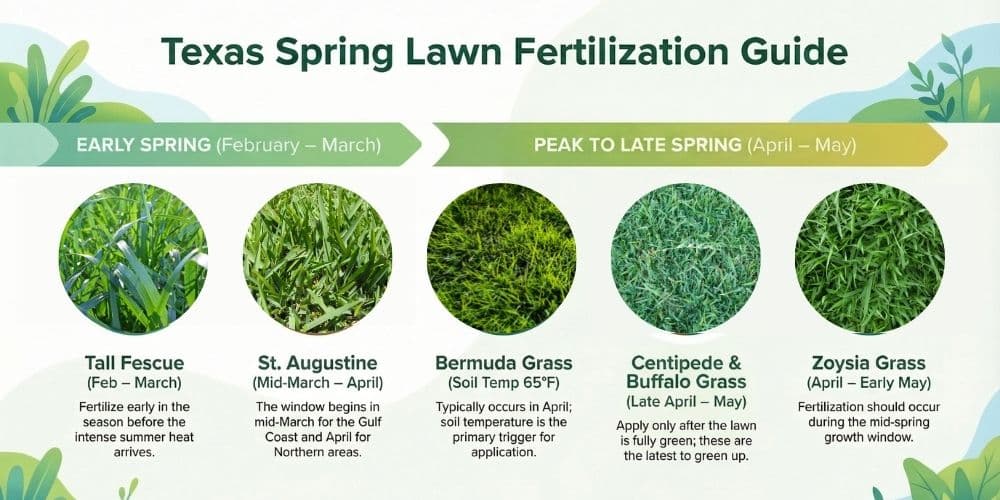
- Spring fertilization window: When soil consistently reaches 65 F, typically April in most of Texas
- First application: Use a 3-1-2 nitrogen-phosphorus-potassium ratio to push green-up
- Frequency: Every 4 to 6 weeks during the growing season
- Annual nitrogen target: 3 to 5 lbs per 1,000 square feet total for the year
- Watch for: Applying too early feeds winter weeds, not your Bermuda
Bermuda + Ryegrass Overseeding Note
If your Bermuda was overseeded with ryegrass last fall, do NOT fertilize with a high-nitrogen program until the ryegrass has fully transitioned out, typically late April to mid-May. Feeding ryegrass delays Bermuda green-up and extends the transition period.
For a full guide on preparing your lawn through the colder months, read our winter lawn care guide.
2. St. Augustine Grass: Dominant Along the Gulf Coast
St. Augustine is the premier lawn grass in Houston, the Gulf Coast, and East Texas. It is shade-tolerant and requires slightly different timing than Bermuda.
- Spring fertilization window: Mid-March to April for Gulf Coast areas; April for areas further north
- First application: Use a slow-release fertilizer with supplemental iron to prevent yellow, chlorotic growth
- Recommended ratio: 4-1-2 or similar high-nitrogen slow-release blend
- Watch for: Early spring fertilization can mask chinch bug damage. Monitor leaf blades closely from April onward
3. Zoysia Grass: Increasingly Popular in Central and North Texas
Zoysia is a dense, slow-growing warm-season grass known for its tight canopy that suppresses weeds naturally. It is the latest of all Texas warm-season grasses to green up in spring.
- Spring fertilization window: April to early May. Do not rush Zoysia.
- Caution: Fertilizing too early produces excessive thatch that smothers the turf
- N-P-K ratio: 3-1-2; keep phosphorus low as most Texas soils already have sufficient P
- Annual nitrogen: 2 to 3 lbs per 1,000 square feet. Zoysia needs significantly less than Bermuda
4. Centipede Grass: East Texas and Southeast Texas
Centipede is sometimes called “the lazy man’s grass” because it thrives on minimal inputs. That reputation is not a joke. Over-fertilizing centipedes is one of the most reliable ways to kill them.
- Spring fertilization window: Late April to May, only after fully green
- Nitrogen limit: Maximum 1 to 1.5 lbs of nitrogen per 1,000 square feet per YEAR total, not per application
- Best fertilizer: Low-nitrogen, zero-phosphorus formula with iron, specifically labeled for centipede
- Critical warning: Centipede HATES phosphorus. Any fertilizer with high P will cause a long-term decline
- Yellow centipede in spring? It needs iron supplementation, not more fertilizer
5. Buffalo Grass: Native Texas Turf
Buffalo grass is Texas’s only native turf grass and is growing in popularity for its extreme drought tolerance and minimal maintenance requirements.
- Spring fertilization window: Late April to May. This grass is very late to green up.
- Fertilization rate: 0.5 to 1 lb nitrogen per 1,000 square feet annually is often more than enough
- Best approach: A light compost top-dressing in early spring often outperforms synthetic fertilizer for buffalo grass
- Warning: Over-fertilizing buffalo grass destroys its drought tolerance and opens the lawn to weed invasion
6. Tall Fescue: Cool-Season Grass in North Texas
Tall Fescue is a cool-season grass used primarily in shaded areas of North Texas and the DFW area. Its spring fertilization program is the opposite of everything above.
- Spring fertilization window: February to March. Fertilize EARLY, before heat arrives.
- Goal: Strengthen fescue before summer heat stress sets in
- N-P-K: Balanced formula like 16-4-8 or 3-1-2 slow-release
- Critical: Do NOT heavily fertilize fescue in late spring, as it accelerates summer decline and disease
- Priority: Fall is actually the most important fertilization period for fescue; spring is a light support feeding only
What Fertilizer to Use: NPK Ratios Explained for Texas
Walk into any Texas nursery or big-box store in spring, and you will face 50 fertilizer options. Here is how to cut through the noise.
Understanding the N-P-K Numbers
Every fertilizer bag shows three numbers, such as 28-0-6 or 15-5-10. These represent:
- N (Nitrogen): Drives green color and blade growth. This is the single most important spring nutrient.
- P (Phosphorus): Root development. Most Texas soils already have more than sufficient phosphorus
- K (Potassium): Stress tolerance, disease resistance, and drought hardiness
Check Your Soil Before You Buy Fertilizer
Texas soils vary wildly by region. The Texas A&M Soil, Water, and Forage Testing Laboratory offers professional soil analysis for around $10 to $15 per sample. Results include specific fertilizer recommendations for your exact soil chemistry. Submit samples (preferably January or February) to get results back before the spring fertilization season begins. This single step saves most Texas homeowners from over-applying phosphorus and potassium that their soil simply does not need.
Recommended Spring N-P-K Ratios by Grass Type
| Grass Type | Recommended Spring Ratio | Notes |
|---|---|---|
| Bermuda | 3-1-2 (e.g., 30-0-15) | High nitrogen, slow-release preferred |
| St. Augustine | 4-1-2 slow-release with Iron | Iron prevents yellowing in alkaline Texas soils |
| Zoysia | 3-1-2 slow-release | Lower application rate than Bermuda |
| Centipede | Low-N, 0-P, with Iron | Never use high-N Bermuda blends on centipede |
| Buffalo | Minimal 1-0-1 or organic compost | Less is genuinely more with buffalo grass |
| Tall Fescue | Balanced 3-1-2 or 4-1-2 | Apply in February to March, not late spring |
Slow-Release vs. Quick-Release Fertilizer in Texas
| Type | How It Works | Best For | Risk in Texas Heat |
|---|---|---|---|
| Quick-Release | Immediate nitrogen hit within days | Fast green-up in early spring | High burn risk above 85 F; must water in immediately |
| Slow-Release | Feeds over 6 to 12 weeks | Most spring and summer applications | Costs more; less immediate visual response |
| Combination | Immediate boost plus long-term feed | Best results for most Texas lawns | Still requires careful rate adherence |
Texas Heat Warning
Never apply quick-release nitrogen fertilizer when temperatures are above 85 F or when your lawn is drought-stressed. In Texas, this combination causes guaranteed fertilizer burn. Always transition to slow-release formulas in late April as temperatures begin climbing.
How Much Fertilizer to Apply: The 1 lb Nitrogen Rule
Over-application is far more common than under-application in Texas, and it causes serious consequences: runoff into waterways, salt buildup in soil, excessive thatch, and increased disease pressure.
The Calculation
Formula: lbs of fertilizer needed per application = 100 divided by the N percentage on the bag
Example: Using a 28-0-6 fertilizer (28% nitrogen):
100 divided by 28 = 3.57 lbs of fertilizer per 1,000 square feet
For a 5,000 square foot lawn: 3.57 multiplied by 5 = 17.85 lbs of fertilizer per application
Fertilizer Rate Calculator
The Purdue University Turf Fertilizer Calculator is a free tool trusted by professional lawn managers across the country. Enter your fertilizer bag’s N-P-K numbers, your lawn size, and your target nitrogen rate, and it calculates the exact amount to apply. Use it every season to avoid over-application errors.
Pre-Emergent Herbicides and Spring Fertilization: Getting the Combo Right
Spring lawn care in Texas almost always requires both fertilization and weed control in the same window. The problem is that most homeowners treat them as separate decisions when they are actually tightly linked. Getting one wrong throws off the other. We have covered both sides of this in depth on the blog: see our complete guide on when to apply pre-emergent herbicide in Texas and our guide on when to apply post-emergent herbicide in Texas for the full treatment. Here is how the two programs interact with your spring fertilization schedule.
Pre-Emergent Always Comes Before Fertilizer
Pre-emergent herbicides work by creating a chemical barrier in the soil that stops weed seeds from germinating. For Texas spring weed control, the primary targets are crabgrass, goosegrass, and spurge. The critical rule is simple: pre-emergent goes down before soil temperatures reach 55°F, which in most of Texas is 3 to 6 weeks before you should be fertilizing. This means the two applications rarely conflict if you follow the correct sequence.
| Step | Application | Soil Temp Trigger | Timing vs. Fertilizer |
|---|---|---|---|
| Step 1 | Pre-emergent herbicide | Apply before soil hits 55°F | 3 to 6 weeks before first fertilization |
| Step 2 | First spring fertilization | Apply when soil reaches 65°F | After pre-emergent has been watered in |
| Step 3 | Post-emergent spot treatment (if needed) | Weeds actively growing | Can be applied alongside or after fertilization |
| Step 4 | Second fertilization (if needed) | 6 weeks after first app | Continue regular weed monitoring |
The Natural Timing IndicatorForsythia Rule:
When forsythia shrubs bloom with bright yellow flowers in your area, crabgrass germination is imminent. This is a reliable natural indicator used by lawn professionals for decades. If forsythia is blooming, apply your pre-emergent immediately.
Can You Apply Fertilizer and Pre-Emergent at the Same Time?
Yes, many products are sold as a combination fertilizer plus pre-emergent (commonly called “Weed and Feed” or “Fertilizer with Crabgrass Preventer”). These are convenient but come with trade-offs:
- More expensive per unit of nutrient than purchasing separately
- You are locked into applying both simultaneously, which may not match your ideal individual timing
- High-nitrogen combination products require strict watering and temperature requirements
- Cannot be used near newly seeded or sodded lawns. Check label timing restrictions carefully
Also Read: How to Get Rid of Weeds
The Texas Soil Test: The Step Almost Nobody Does
Every lawn care professional says the same thing: test your soil before you fertilize. Almost nobody does it. This is precisely why so many Texas lawns look mediocre despite significant money being spent on fertilizer products.
Why Texas Soils Demand Attention
Texas soils are notoriously alkaline, particularly in Central and West Texas. High soil pH, often 7.5 to 8.5, chemically locks out nutrients like iron, manganese, and zinc. This means your grass may look yellow and deficient even when you have applied plenty of fertilizer, because the nutrients are present but chemically unavailable to the plant.
| Texas Soil Type | Common Locations | Typical Challenges | Spring Strategy |
|---|---|---|---|
| Black clay (Vertisols) | Dallas, Fort Worth, Waco | Compaction, poor drainage, high P | Aerate before fertilizing; avoid high-P products |
| Sandy loam | Central Texas Hill Country | Moderate drainage, balanced nutrients | The standard program works well |
| Sandy coastal | Gulf Coast, East Texas | Low nutrients, fast drainage | More frequent, lighter applications |
| Caliche alkaline | West Texas, Midland, Odessa | Extreme alkalinity, nutrient lockout | pH amendment with sulfur before fertilizing |
| Piney Woods sandy acid | Deep East Texas | Acidic pH, low calcium | Lime application may be needed before fertilizing |
Get a Professional Soil Test, Texas A&M
Submit a soil sample to the Texas A&M Soil, Water, and Forage Testing Laboratory for a comprehensive analysis that costs around $10 to $15. The report tells you your exact pH, organic matter content, nutrient levels, and specific fertilizer recommendations tailored to your soil. Collect 10 to 15 soil cores from different areas of your lawn, mix in a clean container, and submit a representative sample. Turn-around is typically 5 to 7 business days.
7 Fertilization Mistakes That Destroy Texas Lawns Every Spring
Mistake 1: Fertilizing Too Early
The single most common mistake. Applying nitrogen to dormant or barely-awake grass in February or early March (in most of Texas) does nothing for your lawn and everything for your weeds. Winter weeds like henbit and annual bluegrass are actively growing in February and will consume the fertilizer you intended for your turf.
Mistake 2: Ignoring Soil Temperature
“My neighbor already fertilized” is not a valid reason to fertilize. Your neighbor may have a different grass variety, a warmer microclimate, or may simply be wrong. Use the Greencast soil temperature map linked above and check your own numbers.
Mistake 3: Skipping the Watering Step
Every granular fertilizer application must be watered in within 24 to 48 hours. In Texas spring, undissolved granules sitting on dry grass blades in afternoon sun will burn your lawn. Apply before a forecasted rain or run your irrigation system immediately after spreading.
Mistake 4: Using the Wrong Product for Your Grass
Applying a high-nitrogen Bermuda fertilizer to centipede grass is not just wasteful it causes long-term turf decline and can kill the lawn over repeated seasons. Always match the product to the grass type.
Mistake 5: Ignoring Weed and Feed Timing Restrictions
Weed and Feed combination products carry strict timing restrictions. Most require 3 to 4 weeks of separation from seeding or sodding. Do not apply when temperatures exceed 90 F or when rain is expected within 24 hours. Read the label completely, not just the front panel.
Mistake 6: Fertilizing Shaded Areas at Full Rate
Grass in shaded areas grows slower, uses fewer nutrients, and is more vulnerable to fungal disease. Apply half the standard rate to shaded lawn sections compared to full-sun areas. This single adjustment reduces disease pressure significantly.
Mistake 7: Fertilizing Over Heavy Thatch
If your lawn has more than half an inch of thatch, fertilizer cannot reach the soil efficiently. Dethatch or aerate before spring fertilization for Bermuda and Zoysia lawns. Products sit in the thatch layer, break down unevenly, and cause patchy results that look like application errors.
When to Apply Lawn Fertilizer: Complete Spring Schedule for Texas
Here is a ready-to-follow schedule for the most common Texas scenario: warm-season grass in Central or North Texas. Adjust the timeline 3 to 6 weeks earlier for South Texas and the Gulf Coast.
| Timing | Task | Product | Key Rule |
|---|---|---|---|
| 4 to 6 Weeks Before Green-Up | Pre-emergent herbicide application | Granular pre-emergent (Dimension or Barricade) | Apply before soil hits 55 F; do not fertilize yet |
| At Green-Up (soil at 65 F) | First spring fertilization | Slow-release plus quick-release combo, appropriate N-P-K for your grass | Water in within 24 hours; check soil temp first |
| 6 Weeks After First App | Second application if needed | Slow-release nitrogen | Only if lawn shows pale coloring or slow growth |
| Late May to Early June | Transition to summer program | High-K, lower-N formula | Reduce nitrogen; increase potassium for heat stress resistance |
Organic vs. Synthetic Fertilizers for Texas Lawns
The Case for Synthetic
Synthetic fertilizers are faster-acting, more precisely formulated, and cheaper per unit of nutrient than most organic alternatives. For Texas lawns where a quick spring green-up is the goal, a quality slow-release synthetic fertilizer matched to your grass type is hard to beat on performance.
The Case for Organic
Organic fertilizers, such as compost, cottonseed meal, blood meal, and feather meal, build long-term soil biology. Texas clay soils that compact easily and drain poorly genuinely benefit from the organic matter content that synthetic products cannot provide. Over multiple seasons, organic programs tend to reduce dependence on inputs as the soil ecosystem improves.
| Factor | Synthetic | Organic |
|---|---|---|
| Speed of green-up | Fast days | Slow weeks |
| Soil biology improvement | Minimal | Significant over multiple seasons |
| Cost per application | Lower | Generally higher |
| Burn risk | Moderate to High | Very low |
| Runoff and environmental risk | Higher | Lower |
| Best suited for | Quick results on established lawns | Long-term soil building and new lawn establishment |
Frequently Asked Questions
Can I fertilize my Texas lawn in February?
For most of Texas, February is too early for warm-season grasses. Soil temperatures in Central and North Texas are typically still below 60 F in February. The exception is South Texas and the Rio Grande Valley, where spring arrives 6 to 8 weeks earlier and February fertilization is appropriate when soil temperatures confirm readiness.
What happens if I fertilize before the last frost?
If you apply nitrogen before the last frost and a late freeze occurs (a real risk in North Texas through mid-March), the new tender growth stimulated by the fertilizer will freeze and die. This causes significant setback and stress without permanently killing the lawn. Check the 10-day forecast and your regional last frost date before any spring application.
Should I add iron with my spring fertilizer in Texas?
In most of Texas especially areas with alkaline soils, yes. Iron deficiency is widespread in Texas turf and shows up as yellowing between the leaf veins, a condition called interveinal chlorosis. Iron sulfate or chelated iron can be applied separately or as part of a fertilizer blend. It dramatically improves color without the risks associated with excess nitrogen.
How long after fertilizing can kids and pets use the lawn?
For most granular fertilizers, once the product has been watered in and the lawn surface is dry typically 24 to 48 hours it is safe for children and pets. Always verify with the specific product label. Weed and Feed products with herbicide components typically require 24 to 72 hours before re-entry. Liquid fertilizers may have shorter intervals.
How do I know if my lawn needs fertilizer or just water?
A simple test: walk across your lawn and look back at your footprints. If the grass blades spring back quickly, the lawn is adequately hydrated. If the footprints remain visible for several seconds, the lawn is drought-stressed and needs water before fertilizer. Never apply fertilizer to a drought-stressed Texas lawn it concentrates salts and causes burn.
The Bottom Line: Your Texas Spring Fertilization Game Plan
Here is the complete action plan, condensed:
- Step 1: Identify your exact grass type. If unsure, contact your local Texas A&M AgriLife Extension county office; they offer free identification help.
- Step 2: Buy a $12 to $15 soil thermometer and monitor soil temperature at 2 to 3 inches daily in the morning.
- Step 3: Check the Greencast Soil Temperature Map for your county’s real-time reading and 5-day forecast.
- Step 4: Apply pre-emergent herbicide before soil reaches 55 F..
- Step 5: Wait for soil to consistently reach 65 F before first fertilization.
- Step 6: Select the correct fertilizer N-P-K ratio for your specific grass type using the tables in this guide.
- Step 7: Apply no more than 1 lb of actual nitrogen per 1,000 square feet per application. Use the Purdue Turf Fertilizer Calculator to calculate the exact amount.
- Step 8: Water the application in within 24 hours.
- Step 9: Repeat every 6 to 8 weeks through the growing season and transition to a lower-nitrogen, higher-potassium summer program by late May.
Texas lawns face brutal heat, periodic drought, unpredictable late freezes, and some of the most variable soil conditions in the country. A properly timed spring fertilization program matched to your specific grass and backed by actual soil temperature data gives your lawn the foundation it needs to perform through the full season. Stop guessing and start measuring.
And if you would rather leave it to the professionals, The Works Lawn Service handles fertilization, weed control, and seasonal lawn care across Round Rock and suburb so your lawn gets the right treatment at exactly the right time.