

If weeds take over your lawn every spring, the problem starts before you see them. In Texas, apply spring pre-emergent when soil temperatures reach 50–55°F; typically mid-February in South Texas, early March in Central Texas, and mid-March in North Texas. For fall, apply before soil temperatures drop below 70°F, usually in September. Timing is everything.
This guide explains when to put down pre-emergent, how pre-emergents work, when to use pre-emergent in Texas, the best types for different situations, and common mistakes to avoid.
What Is a Pre-Emergent Herbicide
A pre-emergent herbicide, commonly called a weed preventer, is a treatment applied before weed seeds germinate. Instead of killing visible weeds, it creates a protective soil barrier that stops new weeds from developing roots and shoots.
Think of it as weed prevention, not weed removal. If weeds are already growing, pre-emergents won’t eliminate them; you’ll need post-emergent control for that.
Benefits:
- Prevents weeds before they grow
- Reduces future weed treatments
- Supports thicker, healthier turf
How Pre-Emergent Herbicide (Weed Preventer) Works

Pre-emergent herbicides work by targeting newly germinating weed seeds. Once applied and watered in, the product forms a thin chemical layer just below the soil surface.
When a weed seed begins to sprout, it absorbs the herbicide and dies before breaking through the soil. This is why proper timing and soil moisture are critical—without activation, the barrier won’t form.
Importantly, pre-emergents do not affect established grass, which makes them safe for most Texas turf types when used as directed.
Types of Pre-Emergent Herbicide
There are several types of pre-emergent herbicides, each suited for different needs and preferences.
Chemical (Synthetic) Pre-Emergents
These are the most common and long-lasting options. They provide consistent weed prevention and are widely used in professional lawn care.
Best for homeowners who want reliable, season-long control with fewer applications.
Organic or Natural Pre-Emergents
Organic pre-emergents rely on natural compounds that inhibit root development. They tend to be less persistent and require precise timing.
These are often chosen by homeowners looking for low-toxicity or environmentally focused options.
Selective vs Non-Selective Pre-Emergents
Selective pre-emergents target specific weed types while remaining safe for turfgrass. Non-selective versions prevent almost all seed germination and are typically used in landscape beds, not lawns.
When to Apply Pre-Emergent Herbicide in Texas
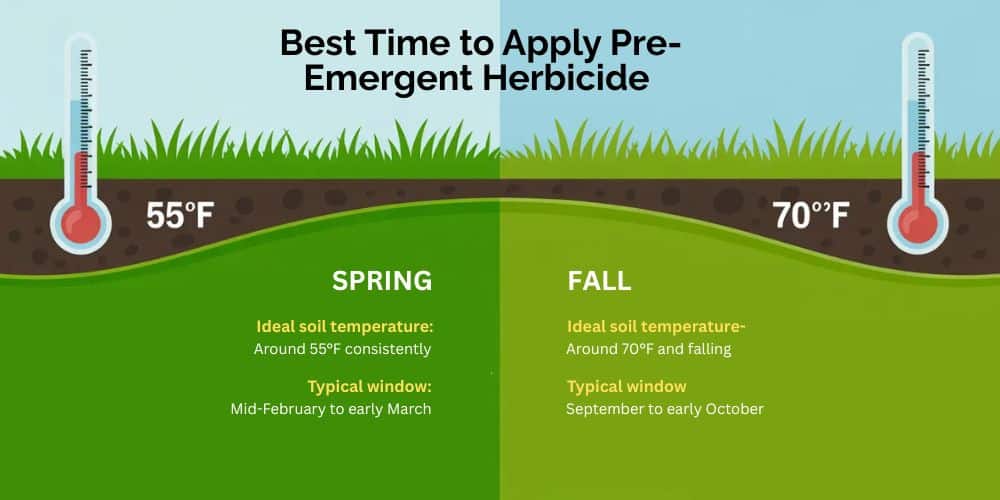
Timing matters more than the product itself. In Texas, homeowners often ask when to use pre-emergent or when to put down pre-emergent, but the real answer depends on soil temperature, not calendar dates. If you apply too late, the weeds are already growing, and prevention fails.
That’s why successful pre-emergent use is about watching the soil, not the month on the calendar.
However, because Texas soil temperatures follow a fairly predictable pattern each year, homeowners can use general timeframes as a planning guide — while still confirming with soil temperature for accuracy.
Texas Pre-Emergent Timeline (Quick Reference)
Texas lawns follow a consistent weed cycle tied to soil temperature trends.
- Spring barrier: mid-February → early March
- Fall barrier: September → early October
These windows align with when soil temperatures typically reach the germination range. Homeowners who miss these periods often end up fighting weeds all season instead of preventing them in the first place.
When to Apply Pre-Emergent in Spring
Spring pre-emergents prevent aggressive summer weeds such as crabgrass, spurge, and goosegrass. These weeds begin germinating as soon as soil temperatures warm consistently.
| Timing Factor | Texas Guideline |
| Ideal soil temperature | Around 55°F consistently |
| Typical window | Mid-February to early March |
| Purpose | Prevent summer weeds |
According to Texas A&M AgriLife Extension, pre-emergents should be applied before soil temperatures stay above 55°F for multiple days in a row. Waiting even one or two weeks too long can allow weeds to slip through.
In warmer parts of South Texas, this window may arrive earlier. In North Texas, it may arrive slightly later. Watching soil temperature is more reliable than guessing based on the region.
When to Apply Pre-Emergent in Fall
Fall applications target cool-season weeds that invade lawns during winter. These weeds germinate when soil temperatures begin dropping after summer heat.
The critical marker is 70°F soil temperature and falling. This signals the start of winter weed germination.
| Timing Factor | Texas Guideline |
| Ideal soil temperature | Around 70°F and falling |
| Typical window | September to early October |
| Purpose | Prevent winter weeds |
Fall pre-emergents stop weeds like annual bluegrass, henbit, and chickweed before they take root and spread through winter. Skipping fall treatment often leads to a lawn that looks thin and patchy by early spring.
Texas Pre-Emergent Timing by Region
Because Texas is geographically large, soil temperatures do not warm up at the same time statewide. The table below gives a general comparison to help homeowners understand regional differences. Always confirm with current soil temperature readings for best results.
Pre-emergent timing in Texas is based on soil temperature measured at 2 inches deep.
| Texas Region | Example Cities | Typical Spring Window (Soil ~55°F) | Typical Fall Window (Soil ~70°F) |
|---|---|---|---|
| South Texas | Houston, Corpus Christi, McAllen | Early to mid-February | Late September- Early October |
| Central Texas | Austin, San Antonio, Round Rock | Late Feb to Early March | Late September |
| North Texas | Dallas, Fort Worth | Late Feb to Early March | Mid to Late September |
| West Texas / Panhandle | Lubbock, Amarillo | Early to Mid-March | Early to Mid-September |
Apply when soil temperatures consistently reach these thresholds, not based on calendar dates alone.
Tools to Get Your Pre-Emergent Timing Right
For exact soil temperature readings in your specific location, the Greencast Soil Temperature Tool allows you to track real-time soil conditions.
For current, temperature-based recommendations by state, the GrassDaddy Pre-Emergent Map provides live seasonal timing guidance.
Checking one of these tools before applying ensures you’re hitting the correct germination window — not guessing based on past averages.
Pre-Emergent Herbicide Timing by Grass Type in Texas
Your grass type determines both when to apply and which products are safe. Using the wrong product or applying it at the wrong growth stage can damage your turf along with the weeds.
| Grass Type | Common Texas Locations | TSpring Window | Fall Window | Safe Active Ingredients | Sensitivity Level | New Sod Wait |
|---|---|---|---|---|---|---|
| Bermuda | Statewide | Late Feb – Early March | September | Prodiamine, Dithiopyr | Low | 6 months |
| St. Augustine | Houston, Gulf Coast, South TX | Early–Mid Feb (South TX); Late Feb (Central/North TX) | September | Prodiamine (label-safe only) | High | 12 months |
| Zoysia | Statewide | Late Feb – Early March | Early–Mid September | Dithiopyr, Prodiamine | Medium | 12 months |
| Centipede | East TX, Southeast TX | Late Feb – Early March | September | Prodiamine (conservative rate) | Very High — most sensitive TX grass | 12 months |
Key Notes by Grass Type
Bermuda: Dormant in winter, which works in your favor. Apply while dormant without risking turf damage. Most forgiving grass type for pre-emergent use.
St. Augustine: Most chemically sensitive common Texas grass. Never exceed label rate. Avoid combination fertilizer + pre-emergent products while the lawn is still dormant.
Zoysia: Breaks dormancy later than Bermuda. Avoid nitrogen-heavy combo products during the dormant period. Dithiopyr is the preferred choice.Centipede: Treat with the most caution. Slow-growing and easily damaged. Avoid high-nitrogen products during dormancy entirely.
One Rule for Every Grass Type
Do not apply pre-emergent if you plan to overseed within 8–12 weeks. Pre-emergents cannot tell the difference between weed seeds and grass seed. Your overseeding will fail.
How to Apply Pre-Emergent Herbicide Correctly

Applying pre-emergent herbicide isn’t complicated, but precision matters. A small mistake in timing or watering can weaken the protective barrier and let weeds slip through. Following the correct process ensures the herbicide forms an even shield across your lawn.
Step 1: Choose the right weather window
Apply when the lawn is dry, and rain isn’t expected for at least 24 hours. Heavy rain immediately after application can push the herbicide too deep into the soil. Mild temperatures and calm winds produce the best results.
Step 2: Mow and clear the lawn first
Mow the lawn and remove leaves or debris before applying. The herbicide needs direct contact with the soil surface. Thick thatch or clutter can block coverage and create gaps in protection.
Step 3: Apply evenly across the lawn
Use a broadcast spreader for granular products or a calibrated sprayer for liquid treatments. Walk in steady lines and slightly overlap passes to avoid untreated strips. Uneven coverage leads to patchy weed control.
Step 4: Water the herbicide into the soil
Most pre-emergents must be watered in within 24–48 hours. Light irrigation activates the chemical barrier. Without water, the herbicide remains inactive, and weeds can germinate normally.
According to Texas A&M AgriLife Extension, proper watering is essential to move the herbicide into the top soil layer where germinating weeds absorb it.
Step 5: Avoid disturbing the soil afterward
Raking, aerating, or aggressive digging can break the protective barrier. Once activated, leave the soil undisturbed so the herbicide continues working.
How Much Pre-Emergent to Apply Per 1,000 Sq Ft
Application rate depends on product type and active ingredient. Always follow the label, but typical ranges are:
| Product Type | Typical Rate Per 1,000 sq ft | Coverage Notes |
|---|---|---|
| Granular (Prodiamine-based) | 2.3 – 4.6 lbs | Provides 3–6 months control depending on rate |
| Granular (Dithiopyr-based) | 3 – 5 lbs | Slight early post-emergent activity |
| Liquid concentrate | Varies by dilution | Calibrate the sprayer carefully |
Under-application weakens the barrier. Over-application can stress turf. Precision matters.
Best Pre-Emergent for Texas Lawns (by Use Case)
Instead of focusing on product names, it’s smarter to choose based on your lawn’s needs.
| Use Case | Best Type |
| Crabgrass prevention | Long-lasting chemical pre-emergents |
| Broadleaf weed prevention | Selective pre-emergents |
| Overseeding plans | Short-residual or seed-safe options |
| Low-toxicity preference | Organic pre-emergents |
| Landscape beds | Non-selective pre-emergents |
Choosing the wrong type can lead to wasted effort or damaged grass, so matching the herbicide to your situation is key.
Best Types of Pre-Emergent Herbicide for Common Texas Weeds
Texas lawns face a predictable set of seasonal weeds. Matching the weed to the right pre-emergent improves success dramatically.
| Common Texas Weed | Season | Recommended Pre-Emergent Type |
| Crabgrass | Spring | Long-residual chemical |
| Annual Bluegrass (Poa annua) | Fall | Selective fall pre-emergent |
| Spurge | Spring | Broadleaf-focused pre-emergent |
| Henbit | Fall | Cool-season weed pre-emergent |
| Chickweed | Fall | Selective pre-emergent |
| Goosegrass | Late spring | Extended-control pre-emergent |
The University of Arkansas Cooperative Extension and Texas A&M both highlight the importance of weed-specific timing and selection for effective control.
Missed the Pre-Emergent Window? Here’s What to Do
If soil temperatures already crossed 55°F in spring or 70°F in fall and weeds are emerging, pre-emergent will not help.
Here’s your next step:
- Switch to a post-emergent herbicide to kill visible weeds.
- Spot treat aggressively before they seed.
- Plan your next pre-emergent application correctly for the following season.
Many Texas homeowners realize they missed the window only after crabgrass appears. At that point, professional treatment often prevents the problem from spreading.If you’re unsure whether it’s too late, The Works Lawn Service can evaluate your lawn and apply the correct treatment strategy, prevention if possible, correction if necessary.
Pre-Emergent vs Post-Emergent Herbicides
This is one of the biggest sources of confusion for homeowners. Many people expect one product to do everything, but pre- and post-emergent herbicides serve completely different roles in lawn care. Understanding the difference helps you choose the right tool at the right time.
Pre-emergent herbicides are preventive. They stop weeds before they ever break the soil surface. Post-emergent herbicides are corrective. They attack weeds that are already visible and growing. Think of pre-emergent as a shield, and post-emergent as a treatment.
| Feature | Pre-Emergent | Post-Emergent |
| Purpose | Prevent weeds | Kill existing weeds |
| Application timing | Before germination | After weeds appear |
| Best use | Long-term prevention | Spot treatment |
| Works on visible weeds | No | Yes |
| Seasonal role | Early spring & fall | Anytime weeds appear |
In a Texas lawn, the two are often used together as part of a yearly strategy. Pre-emergents reduce the number of weeds that ever sprout, while post-emergents clean up the few that slip through. Using both correctly means fewer chemicals overall, less lawn stress, and a healthier turf year-round.
Common Mistakes Texans Make With Pre-Emergent Herbicides
Most pre-emergent failures aren’t product problems; they’re timing and application mistakes. Even a high-quality herbicide won’t work if it’s applied incorrectly. Understanding these common errors can save you a full season of frustration.
1. Applying too late
Pre-emergents only work before weeds germinate. If crabgrass or other weeds are already visible, the barrier is useless. Many homeowners wait until they see weeds, which is already too late.
2. Relying on calendar dates instead of soil temperature
Texas weather changes every year. A fixed date like “March 1” is unreliable. Pre-emergents should be timed by soil temperature, not the calendar. Weeds germinate when soil hits about 55°F, sometimes earlier in warm winters.
3. Failing to water the herbicide into the soil
Most pre-emergents must be watered within 24–48 hours. Without activation, the protective barrier never forms. Light irrigation or rainfall is essential for the product to work.
4. Applying right before heavy rainfall
While water is needed, excessive rain can wash the herbicide too deep into the soil. This weakens the barrier and reduces effectiveness. Moderate watering is ideal — flooding is not.
5. Expecting pre-emergents to kill existing weeds
Pre-emergents prevent new weeds, but they do nothing to weeds that are already growing. If weeds are visible, you’ll need a post-emergent treatment first.
Avoiding these mistakes dramatically increases your success rate. When timing, watering, and expectations are correct, pre-emergents are one of the most reliable weed-control tools available.
Is Pre-Emergent Herbicide Safe for Pets and Lawns
When used according to the label, most pre-emergent herbicides are considered safe for established lawns.
For pets and children:
- Keep them off the lawn until the product is watered in and dry
- Follow label re-entry instructions carefully
- Consider organic options if exposure concerns are high
The Environmental Protection Agency (EPA) emphasizes that proper label use is the key factor in herbicide safety.
Final Thoughts on Pre-Emergent Herbicide for Texas Lawns
If you want fewer weeds, a healthier lawn, and less frustration, pre-emergent herbicide is one of the smartest tools you can use in Texas. Apply it at the right time, choose the right type, and you’ll stop weeds before they ever become a problem.
If you’d rather have a professional handle the timing and application, The Works Lawn Service provides expert weed control and pre-emergent treatments tailored to Texas lawns so you get real protection without the guesswork.
Frequently Asked Questions About Pre-Emergent Herbicide in Texas
Can I apply pre-emergent in February in Texas?
Yes. February is often ideal, especially in North and Central Texas, as long as soil temperatures are approaching 55°F.
When to apply pre-emergent in North Texas?
Late February to early March is typical, but soil temperature is the real indicator. Apply just before soil reaches 55°F.
When to apply pre-emergent in Houston (South Texas/Gulf Coast)?
Houston lawns typically require spring pre-emergent in early to mid-February, because Gulf Coast soil warms earlier than the rest of the state. Monitor soil temperatures closely and apply before they hold at 55°F for several consecutive days. Fall applications usually occur in late September as soil temperatures drop toward 70°F and fall.
Will pre-emergent kill grass seed?
Most pre-emergents prevent grass seed from germinating, which is why timing around overseeding matters.
How long does pre-emergent herbicide last?
Depending on the type, protection can last anywhere from 2 to 6 months.
Do I need to reapply every year?
Yes. Pre-emergents break down over time and must be reapplied for continued protection.
Is February too early for pre-emergent in Texas?
No. In warmer years, February is ideal. Waiting until March can allow weeds to germinate first.
What happens if I apply pre-emergent too late?
The barrier forms after weeds have already sprouted, making prevention ineffective.